Martyrs and scapegoats
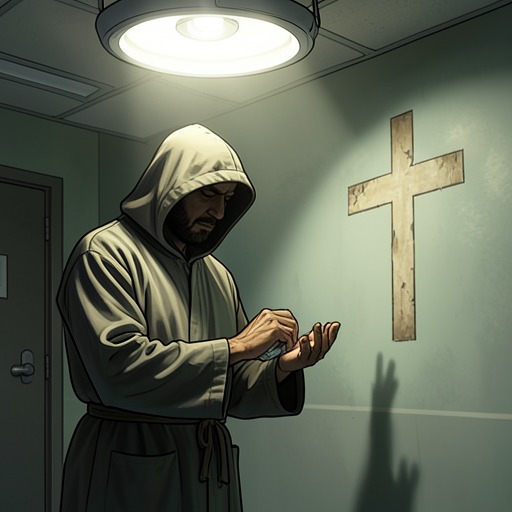
The Good Nurse: A True Story of Medicine, Madness, and MurderMartyrs and scapegoats names a recurring tension in the book: the difference between being made to bear blame and imagining oneself as a martyr. The Christian story of Saint Barnabas gives Charles Cullen a language for suffering, remembrance, and persecution. Later, amid hospital investigations and departures from jobs, he reuses that language to present himself as the wronged party. The pattern matters because the book places his claims beside concrete events that complicate them: an insulin investigation at Saint Barnabas Medical Center, his own angry resignation from Hunterdon Hospital, and the evidence raised at Saint Luke’s Medical Center. Victimhood is both a real institutional possibility and, in Cullen’s account, a defense against responsibility.
The Saint and the Reversed Life
The motif begins with a church image: Saint Barnabas appears in a stained-glass archway as a bearded figure, a companion to Luke and Paul. The prayer associated with him praises a life given for the well-being of the church rather than for personal renown. Cullen has little use for those prayers. While preparing to marry Adrianne Cullen, he formally renounced the religion of his upbringing and converted to Judaism; the narrative describes him as feeling that he was living the saint’s life in reverse.
The reversal is more than religious biography. The book dwells on the violent endings of saints—stoning, prison, and other forms of bodily punishment—and on the paradox that a person may be remembered forever only after being hated to death. Barnabas’s martyrdom thus supplies Cullen with a powerful imaginative script: the righteous person is misunderstood, made to suffer, and remembered after the fact. The script binds injury to moral distinction. To suffer is not merely to be harmed; in this story, it can become evidence that the sufferer was good.
Saint Barnabas Medical Center and the Scapegoat Story
On January 10, 1992, Cullen explained his departure from Saint Barnabas Medical Center to Adrianne as an internal political struggle. He said a nurses’ strike was pending and that he had opposed it because patients would suffer. In his telling, taking a principled stand against the strike had turned him into a target of nursing administrators and a revenge campaign. The book marks the appeal of this account in Adrianne’s perception: she could see something of the old Cullen in his apparent commitment to putting patients before paychecks.
He then connected the supposed retaliation to a separate and alarming matter at the hospital: someone had been injecting insulin into saline IV bags in storerooms. Cullen described the bags’ injection ports, explaining that punctures could be difficult to see with the naked eye and that a microscope might reveal a port punctured repeatedly. He said that patients had crashed and required codes, and that the number who might have been affected was uncertain, perhaps large. His technical fluency made the account vivid, while its horror and his excitement sat uneasily together.
Cullen told Adrianne that the hospital had investigated without identifying who was responsible, and that administrators needed a scapegoat to cover their embarrassment. He presented himself as that scapegoat: the focus of an internal investigation and the person let go despite having done the right thing. Adrianne found the explanation incoherent, but allowed it to stand. The distinction is important: the book establishes what Cullen told her, not that his claim of being targeted was true. His story converts a disturbing hospital investigation into a narrative of his own persecution, and his wife’s uncertainty leaves the account neither fully endorsed nor directly confronted.
Resignation as Martyrdom
At Hunterdon Hospital, the martyr figure reappears through an action Cullen himself takes. After his supervisor, Marjorie Whelan, warned him that another incident would mean termination, he reacted by saying he would quit. He returned home and typed a resignation in capital letters and emphatic punctuation, surrendering 170 hours of paid vacation accrued through perfect attendance. He drove to a mailbox, pushed the letter through, and reopened the slot to make sure it was gone. Only then did he grasp what he had done and hurry to draft another letter, too late to retrieve the first.
The book calls the gesture a kind of suicide: a dramatic sacrifice of money and security that briefly made Cullen feel powerful and righteous. Hunterdon accepted the resignation and offered him per diem shifts, but he never appeared for them. He stayed in his rented basement room while calls rang unanswered, taking satisfaction in the silence as if ignoring the hospital could demonstrate his control. When the calls stopped, that imagined audience disappeared. A final letter wished him luck in his future career, and he turned to a typewriter again, this time borrowing the formal style of correspondence from his wife’s lawyers to argue that the hospital’s treatment of him was unfair.
His reasoning, as the book sets it out, turns on a contradiction. If the hospital considered him dangerous and unstable, he argued, it should not have placed him on the schedule or offered him per diem work. From those premises he concluded that he was not dangerous, that complaints against him were unfair, and that he alone was the victim. The narrative emphasizes what this argument excludes: the possibility that an institution might make inconsistent decisions, or that being retained for shifts does not prove that concerns are baseless. Hunterdon never replied. The episode cost Cullen six weeks of unemployment and the 170 hours he had surrendered; the lesson he drew was not how to reassess his conduct, but never to put it in writing again.
The Righteous Man at Saint Luke’s
At Saint Luke’s Medical Center, the conflict between martyrdom and evidence becomes sharper. Cullen heard an investigator list shifts associated with medication incidents and describe the preparation of a dangerous drug. Records, blood work, laboratory reports, and vials were present. Rather than treating these details as grounds for scrutiny, Cullen experienced the questioning as bullying and said the investigators had already made up their minds.
He was offered a choice: resign in return for neutral references and an incident that would not appear on his record. He accepted the arrangement, while continuing to regard himself as the righteous party being discarded. Security escorted him through the unit and left him in the parking garage. Cullen recast the removal in the language of Christ’s passage to Calvary, and disparaged the hospital as a place protecting its reputation. That comparison completes the motif’s double movement: institutional self-protection may be part of the setting, but Cullen’s martyr language also transforms an exit under investigation into proof of his innocence.
The book does not make every institutional action equivalent to a false accusation, nor does Cullen’s conviction settle what happened. Instead, it makes the reader watch how easily a story of sacrifice can absorb contrary facts. The saint’s suffering leads to lasting remembrance; Cullen’s self-made sacrifices produce lost pay, silence, and another departure. Between those outcomes lies the central ambiguity of martyrs and scapegoats: the language can expose the cruelty of misplaced blame, but it can also let a person mistake punishment, scrutiny, or consequence for evidence of righteousness.